Trusted Babysitters in South Africa: How to Choose One

A trusted babysitter is someone you’ve checked yourself: identity, three references, a proper conversation and a short trial. No app, agency or website can do that last mile for you. What a good platform can do is save you time, show you complete profiles and let you talk to people directly. This guide walks you through the checks that matter, in the order we’d do them.
We’re AuPairly, an online platform where South African families message au pairs directly. We’ll tell you plainly what we do and what we don’t, because that’s part of choosing well.
TL;DR
- Trust is built by you: check ID, call references, meet the person, and run a short paid trial before leaving them alone with your children.
- No platform can promise complete safety. Our admin team reviews every au pair profile for completeness, quality and authenticity before it goes live. That’s a quality gate, not a background check.
- Every au pair on AuPairly provides 3 references. Call all three.
- Police clearance, ID and reference checks are available as optional add-ons, so you can choose what you need.
- Babysitters and au pairs are employees in the eyes of the law, so pay at least the national minimum wage and sort out UIF.
Table of Contents
- What “trusted” really means
- What we check, and what we don’t
- A step-by-step way to choose
- Safety basics worth checking
- Babysitter, au pair or daycare?
- Pay and the legal side
- Our view: why we built it this way
- Finding someone on AuPairly
- Red flags to watch for
- A quick checklist you can save
- FAQ
- Sources
What “trusted” really means
When parents search for a trusted, reliable or “vetted” babysitter, they usually want the same thing: to leave the house and not worry. That’s a fair thing to want.
But the word “vetted” is used loosely. Some providers mean a phone interview. Some mean a reference call. Some mean a criminal record check. These are very different things, so always ask what was actually done, by whom and when.
The South African Police Service advice to parents is simple on this point: do a background check on any child minder you employ. The responsibility sits with the family, even when a platform or agency helps you along.
So think of trust as three layers:
- Is the profile real and complete? Does it have a photo, experience, availability and references?
- Is the person who they say they are? ID, references and a conversation answer that.
- Is this person right for your child? Only a meeting and a trial answer that.
A platform can help with the first layer. You handle the second and third, and we’ll show you how.
What we check, and what we don’t
We’d rather be upfront here than have you assume.
What we do: an admin reviews every au pair profile before it goes live. We look at completeness, quality and authenticity. Is the profile filled in properly? Does the information make sense? Does it look genuine? Profiles that don’t pass don’t go live. Think of it as a quality gate.
What we don’t do: we don’t run criminal record checks on every au pair by default, and we don’t verify employment histories. Families do their own final checks. That’s true of every platform where you hire someone directly, whatever the marketing says.
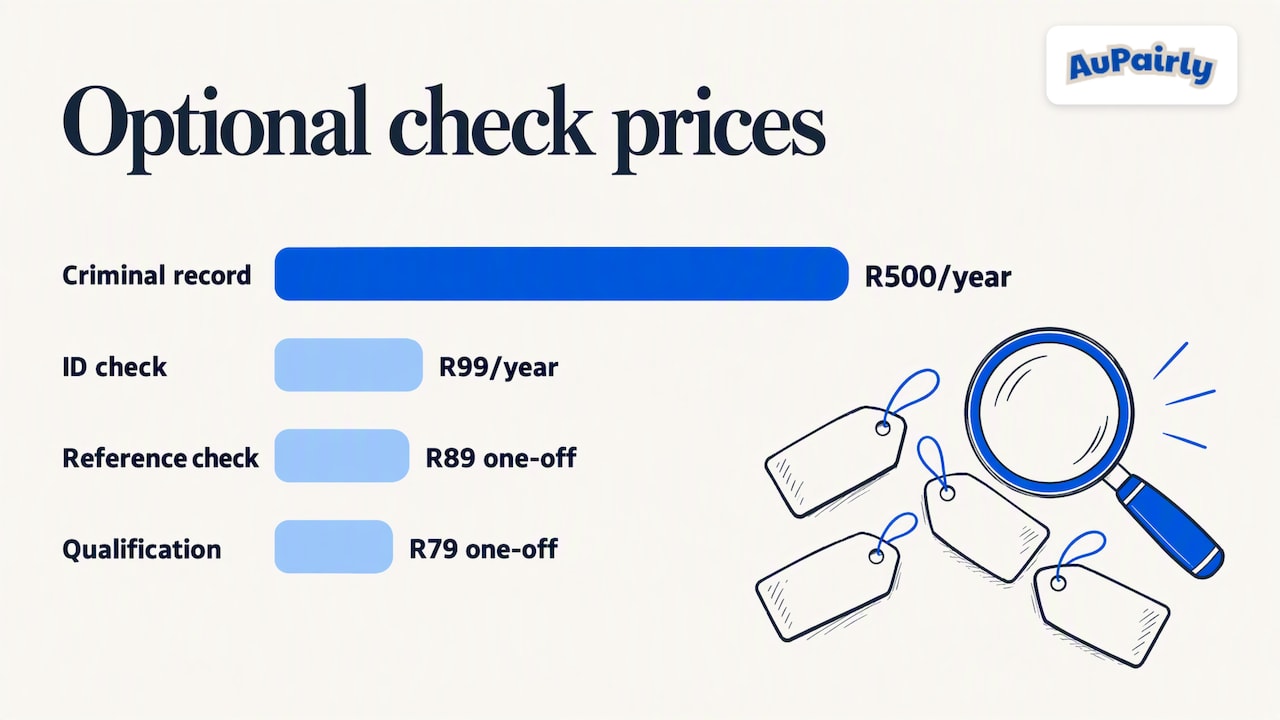
What you can add: if you want more, you can order optional checks. These are listed on our partner and checks page:
| Optional check | Price |
|---|---|
| Criminal record check | R500 per year, per check |
| ID check | R99 per year |
| Reference check | R89, one-off |
| Qualification check | R79, one-off |
So if you want a criminal record check, it’s there as an add-on. We just won’t pretend it’s included in every profile.
Our family safety guide goes through this in more detail.
A step-by-step way to choose
Here’s the order we’d follow if we were hiring for our own kids.
Step 1: Read the profile properly
A good profile tells you a lot before you’ve said a word. Look for:
- Clear, recent photo
- Real childcare experience, with ages of the children
- Languages spoken, which matters for many households
- Availability that matches yours, including evenings or weekends
- Whether they drive, if you need school runs
- First aid training, if listed
- Their three references
If you’re looking for a longer-term au pair rather than an occasional sitter, our guide to profile details that save time shows what to look for and what to skip.
Step 2: Message first
Use direct messaging for a first chat. Pay attention to how quickly they reply, how clearly they write and whether their answers fit their profile. Ask about their experience with your child’s age group. Someone who has only minded toddlers may not be the right fit for a teenager’s homework and lifts, and vice versa.
Step 3: Ask questions that show judgement
Skip the generic “do you like children?” Everyone says yes. Try these instead:
- What would you do if my child refused to go to bed?
- What would you do if my child got a fever while we were out?
- Have you ever had to deal with an emergency? What happened?
- How do you handle a child who won’t eat?
- How do you feel about screen time rules?
- What would you do if someone came to the door?
You’re listening for calm, practical answers. A candidate who says “I’d phone you straight away, then follow the plan you left” is usually a better sign than one who promises everything will be fine.
Step 4: Check identity
Ask to see their South African ID or passport and valid work permit, if they aren’t a citizen. Check that the name matches the profile. If you’d like us to handle this, the ID check add-on exists for that purpose.
Step 5: Call all three references
Every au pair on AuPairly provides 3 references. Don’t just collect them. Phone them.
Ask each referee:
- How do you know this person, and for how long?
- What were they responsible for?
- Were they punctual and reliable?
- Would you hire them again?
- Is there anything you’d want to know if you were in my position?
Listen to hesitations as much as answers. A referee who says “oh yes, she was great” and then goes quiet needs a follow-up question. If a reference is a relative or a friend, say so to yourself and weigh it accordingly.
Step 6: Think about police clearance
The SAPS advice to parents is to run a background check on child minders, and asking for police clearance is a reasonable request. It does take time, though. According to the SAPS page on clearance certificates, the certificate requires fingerprints taken by the police and is described as being for people who need to confirm their criminal status for emigration, or for travel or employment abroad. So ask the candidate if they already hold a recent certificate, and don’t be surprised if they don’t.
If you want a faster route, our optional criminal record check is the add-on for it. Whichever way you go, tell the candidate why you’re asking. A responsible au pair will understand. Parents ask because the children matter, and good candidates know that.
Step 7: Meet in person, then do a paid trial
Before the first solo evening, meet at your home with your children present. Watch how the child reacts and how the sitter responds. Then book a short paid trial while you’re at home or nearby. Pay for the trial. It keeps things professional and fair.
A short trial also lets you see practical things: do they follow your routines, put phones away, wash hands before feeding, ask when unsure?
Safety basics worth checking
- First aid: ask whether they have first aid training, and about infant or child CPR in particular. SAPS guidance for people who bring professionals into the home points to first aid training as a core competency in urgent situations.
- Emergency list: leave a printed sheet with your numbers, a neighbour’s number, your doctor, the nearest hospital, and your address.
- House rules: visitors, phone use, screen time, food allergies, medication and bedtime.
- Online safety: SAPS also advises parents to keep an eye on children’s phones and internet use, and to know who they’re communicating with. Make sure your sitter knows your rules on devices.
- Check in: a quick message during the evening, especially early on.
For evening bookings, we’ve put together a list of details to send before booking. For couples heading out, the date night guide covers safety and handover.
Babysitter, au pair or daycare?
We get this question a lot, and the honest answer depends on your week.
- A babysitter suits one-off or occasional needs: a date night, a wedding, a Saturday. See our guides to weekend babysitting and booking a babysitter for a wedding.
- An au pair suits regular, predictable help, such as after-school care or school runs. Au pairs focus on childcare, not heavy housework. Our au pair duties guide explains where that line sits.
- Daycare suits younger children who benefit from a group setting and a fixed routine. Our piece on daycare or a babysitter covers age advice and safety checks.
Many au pairs on our platform also do babysitting, so you can use AuPairly for occasional or last-minute evenings as well as regular care. We offer urgent babysitting requests for exactly those “we need someone tonight” moments.
Pay and the legal side
A trusted arrangement is a fair one. In South Africa, domestic workers, which includes babysitters and nannies, are covered by the national minimum wage. The Department of Employment and Labour gazette sets the rate that applies from 1 March 2026, and Recording Law’s summary explains that domestic workers are entitled to it for every ordinary hour worked, with paid leave and sick leave on top.
We don’t quote hourly rates ourselves. For a starting point, use our au pair salary calculator, and make sure whatever you agree is not below the legal minimum.
A few practical points:
- Agree pay, hours and transport in writing before the first shift.
- Register for UIF if the person works for you regularly. Our weekend babysitter guide covers UIF basics.
- Pay on time. Reliable people stay with families who respect their time.
Au pairs can read about their own rights in our au pair safety guide.
Our view: why we built it this way
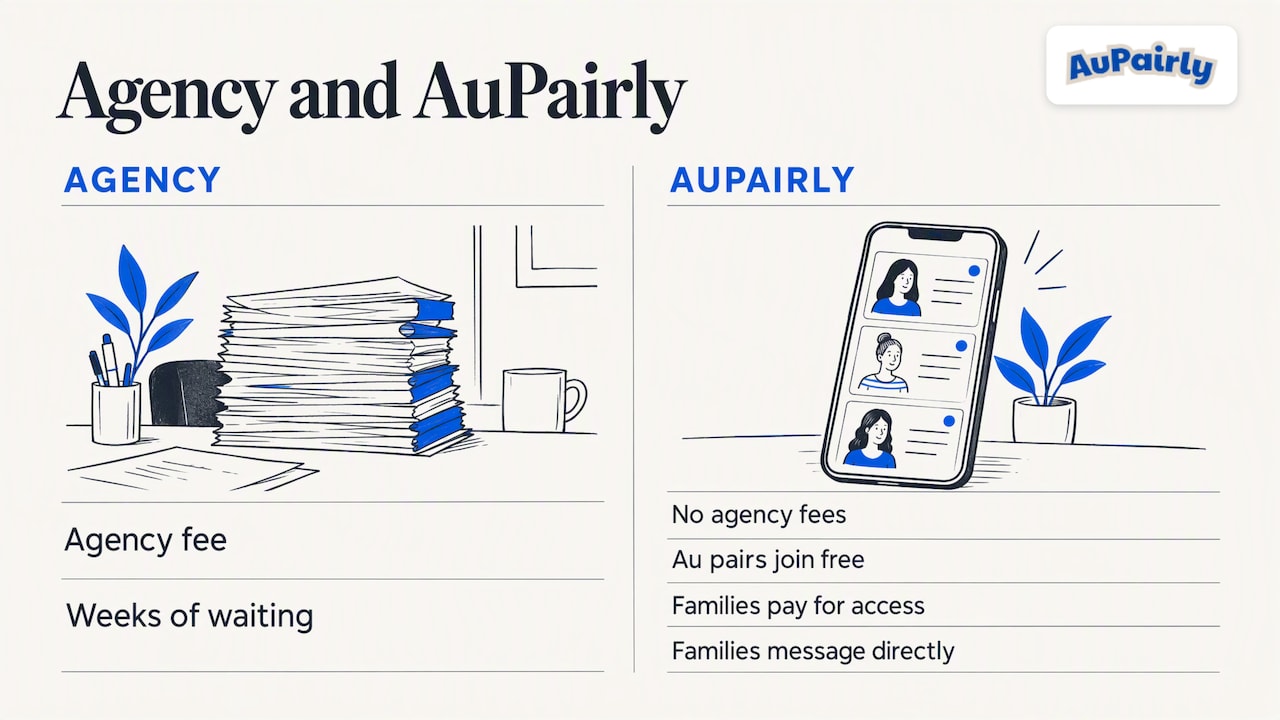
We started AuPairly because finding a good au pair or sitter shouldn’t mean paying an agency fee and waiting weeks. Most families we talk to are busy and practical. They want to see real people, message them directly and decide for themselves.
That’s why there are no agency fees. Au pairs join for free. Families pay for access so they can message and hire, and that’s all.
We’ve also been careful not to oversell. It would be easy to put a “safe” badge on every profile. We don’t, because it wouldn’t be honest. A profile review tells you the profile is complete and looks genuine. It doesn’t tell you whether someone is right for your six-year-old, and it doesn’t replace a reference call.
What we can do is make your side of the work easier. Complete profiles mean fewer wasted messages. Region filters mean you see people in your city or province. A mobile-friendly app means you can reply to a candidate from the school pickup line. The final judgement is yours, and we think that’s how it should be.
— Nicole
Finding someone on AuPairly
If you’re ready to start, you can browse reviewed au pair profiles by area across South Africa, from Cape Town to Johannesburg and beyond. Our plans are simple:
- 7-Day Access: R249 per week
- 30-Day Access: R449 per month
Both let you message au pairs directly. See the pricing page for what’s included. If you’d rather have a single plan that covers a more regular need, the weekly one suits a quick search, and the monthly one suits a thorough one with interviews and trials.
Are you an au pair? You can register for free and message families at no cost.
Red flags to watch for
None of these means someone is unsafe, but each one deserves a closer look:
- A profile with no references, or references that can’t be reached
- Reluctance to show ID
- Vague answers about past families
- Pressure to move the conversation off the platform quickly or to arrange cash payment with no discussion
- Late or missed replies before you’ve even hired them
- Dismissing your house rules in the first conversation
- A child who is clearly uneasy after the trial
Trust your gut. If something feels off, step back. You don’t owe anyone an explanation for choosing someone else.
If you ever have a real concern about a child’s safety, the SAPS and the Department of Social Development hotlines mentioned in the SAPS guidance are there to be used.
A quick checklist you can save
- Read the profile and note anything unclear.
- Message and ask scenario questions.
- See ID.
- Call all three references.
- Ask about police clearance, or order the optional criminal record check.
- Confirm first aid training.
- Meet at home with your children.
- Run a paid trial.
- Agree pay, hours and UIF in writing.
- Leave an emergency sheet and check in.
More guides are on our blog if you want to go deeper on any step.
FAQ
How do you know if you can trust a babysitter?
You find out by checking, not by guessing. See their ID, call all their references, meet them with your children present and run a short paid trial. Add a police clearance or an optional criminal record check if that gives you peace of mind. Keep watching how your child responds after each visit.
Are the au pairs on AuPairly vetted?
An admin reviews every profile for completeness, quality and authenticity before it goes live, and every au pair provides 3 references. We don’t call that security vetting or a background check, and we don’t verify employment history. Families do their own final checks, and optional add-ons such as a criminal record check are available.
What should I pay a babysitter in South Africa?
At minimum, the national minimum wage that applies to domestic workers, which was updated on 1 March 2026 according to the official gazette. Our salary calculator can help you work out a fair arrangement. Agree the amount in writing before the first shift.
Can I book a babysitter at short notice?
Yes. We support urgent babysitting requests, and many au pairs on the platform also take occasional babysitting. For last-minute bookings, still check the profile and references, and ask the sitter to arrive a little early so you can brief them and show them the house.
Sources
- SAPS advice for parents on child minders and online safety
- SAPS: applying for a Police Clearance Certificate
- Department of Employment and Labour: National Minimum Wage amendment 2026
- Recording Law: Domestic worker rights in South Africa (2026)
Recommended
- Daycare or Babysitter in South Africa: Age Advice, Safety Checks
- Evening Babysitting: 9 Details to Send Before Booking in South Africa
- Babysitter for Weddings: How to Book One in South Africa
- Weekend Babysitter: 6 Checks and UIF Basics for South African Parents
Quick note: This was written with AI, and then reviewed by our lovely team of 4. We’ve edited to make sure it doesn’t sound like a computer wrote it, but if it reads more robot overlord than human copywriter please let us know. 😊