Au Pair Working Hours in South Africa: What's Fair and Legal

The short answer: an au pair who works in your home is an employee, so the normal South African limits apply. That means no more than 45 ordinary hours a week, plus overtime that is capped, agreed and paid at a higher rate. Most families don’t need anywhere near that ceiling. What matters more is agreeing a clear weekly schedule in writing before day one.
We’re a small team that sees how families and au pairs sort this out every day. Below we explain the legal limits, how overtime and rest work, what to put in the agreement, and how notice works if things change.
TL;DR
- The law caps ordinary hours at 45 a week, with daily limits of 9 hours (five days or fewer) or 8 hours (more than five days).
- Overtime is limited to 10 hours a week, needs agreement, and is paid at 1.5 times the normal wage or swapped for paid time off.
- Your au pair needs 12 hours of rest between shifts and 36 consecutive hours off each week, unless a written agreement says otherwise within the rules.
- Put hours, days, duties, pay and notice in a written contract.
- Notice is one week in the first six months and four weeks after that.
Table of Contents
- How many hours can an au pair work in South Africa?
- The legal limits at a glance
- What a realistic week looks like
- Live-in au pairs: the rules around rest
- Overtime: how it works and what it costs
- Babysitting is different
- What your hours agreement should include
- Notice periods: ending the arrangement properly
- Our view on hours
- Finding an au pair whose hours match yours
- FAQ
- Sources
How many hours can an au pair work in South Africa?
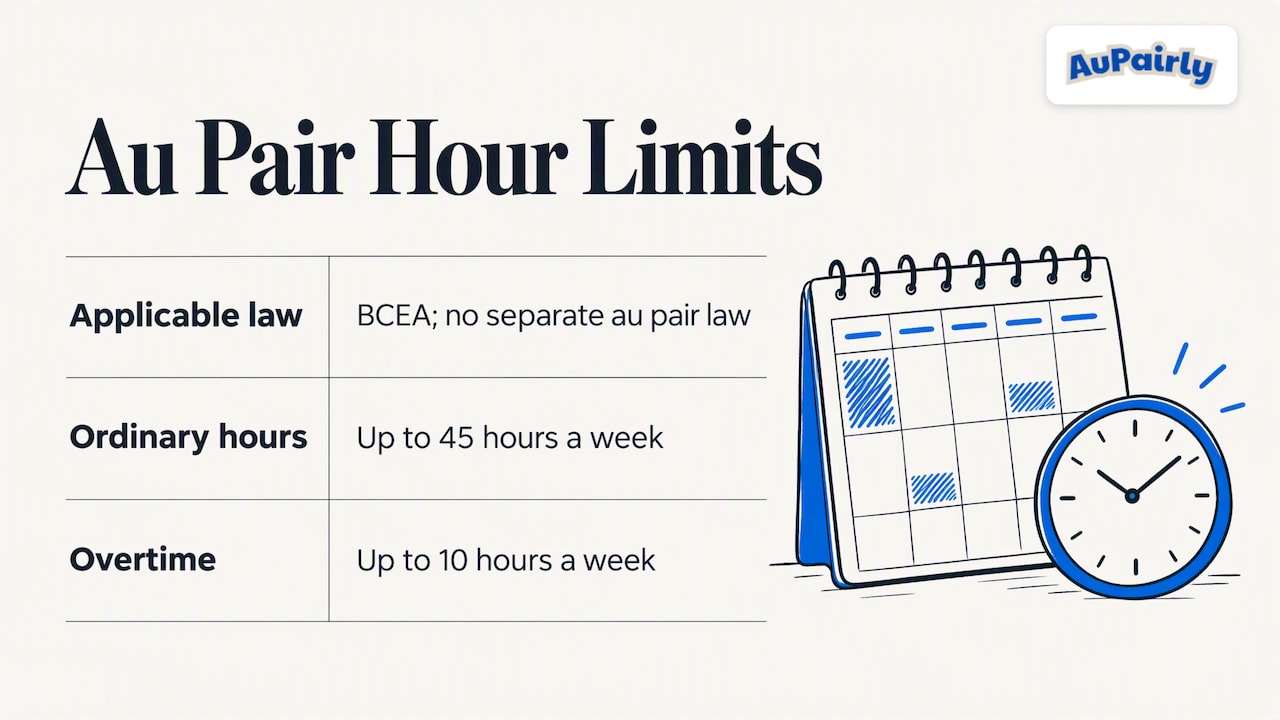
South Africa doesn’t have a separate au pair law. If you employ someone to look after your children in your home, the Basic Conditions of Employment Act (BCEA) sets the ceiling. Ordinary hours are capped at 45 a week. On top of that, an employee may work up to 10 overtime hours a week.
That is the maximum, not the target. A 45-hour week is a full-time job. Many au pair arrangements are built around school hours, afternoons and a few evenings, which is often well below the cap. Some families need a lot more cover than others, so the right number depends on your household and on what you and your au pair agree.
One thing we’d say plainly: the more hours you ask for, the more it looks like a full-time nanny role. If you want long, fixed weekday hours, say so honestly in your advert. Our guide to au pair duties in South Africa explains where childcare ends and heavy housework begins.
The legal limits at a glance
Here’s what the BCEA says, in plain words.
| What | Limit |
|---|---|
| Ordinary hours per week | 45 |
| Ordinary hours per day, five days a week or fewer | 9 |
| Ordinary hours per day, more than five days a week | 8 |
| Overtime per week | 10 hours, by agreement |
| Overtime pay | At least 1.5 times the normal wage |
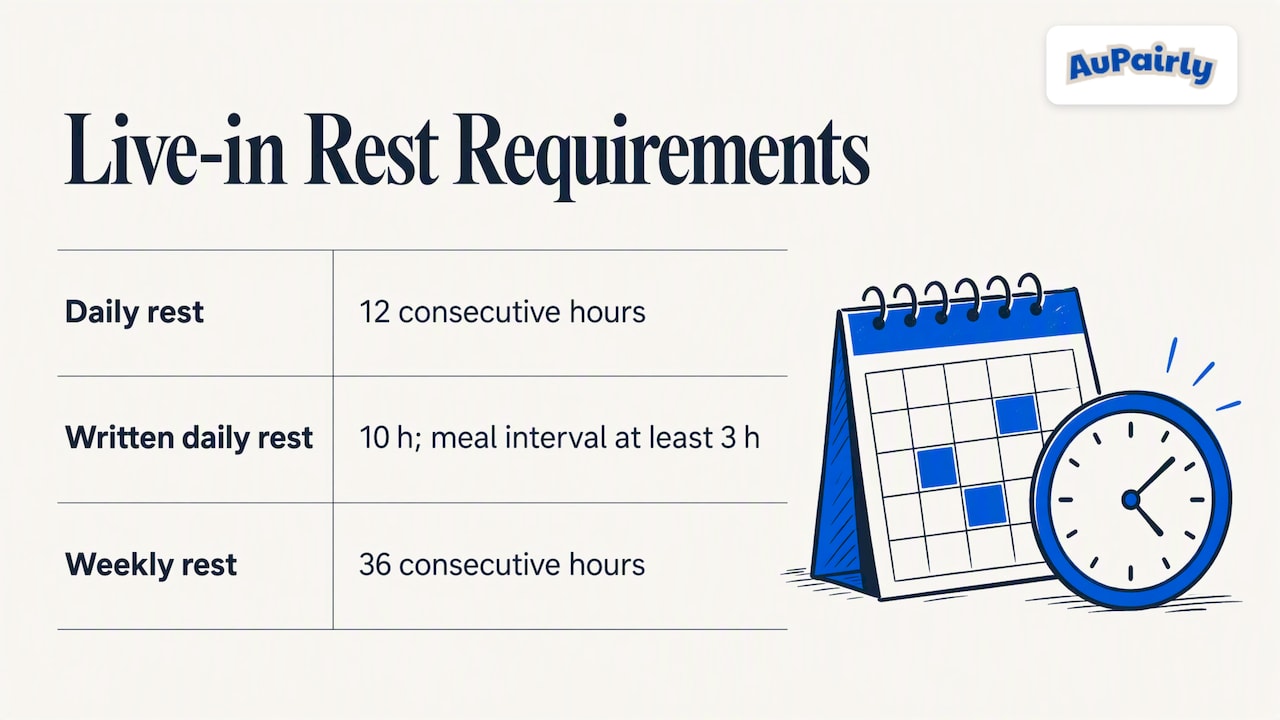
| Daily rest | 12 consecutive hours |
| Weekly rest | 36 consecutive hours |
| Minimum pay for a day worked | 4 hours’ pay, even if she works less |
All of these come from the BCEA. Written agreements can adjust some of them, but only within what the Act allows. If you’re unsure, ask the Department of Employment and Labour before you sign anything.
What a realistic week looks like
We won’t pretend there’s one standard. Here are three common patterns we see families describe, as examples to adapt, not rules.
- School-hours cover. Your au pair collects the children, helps with homework, supervises afternoon activities and has dinner ready for the kids. You’re home by early evening.
- Early start and afternoon. She does the morning routine and school run, has a break while the children are at school, then returns for the afternoon shift. A split day like this works if you agree it upfront and the daily rest rule is respected.
- Occasional evenings and weekends. Most weeks are quiet, but you have a few date nights or work events. These hours need to be agreed in advance and counted.
Write your own version down day by day. “Monday to Friday, 13:00 to 18:00” is clear. “Afternoons, as needed” isn’t.
Live-in au pairs: the rules around rest
If your au pair lives with you, the line between work and home life blurs fast. Living in your house doesn’t mean she’s on duty all day.
The BCEA requires 12 consecutive hours of rest each day. For a live-in worker, a written agreement can reduce that to 10 hours, provided there’s a meal interval of at least three hours during the working day. She also needs 36 consecutive hours off each week. Written alternatives are possible, but they must stay within the Act.
In practice, that means a live-in au pair shouldn’t be asked to get up for a crying child at 5 am after finishing at 10 pm the night before, every day. If night cover is part of the deal, put it in the contract and count the hours.
Live-in arrangements also come with accommodation rules. Our guide on making au pair accommodation lawful walks you through the steps.
Overtime: how it works and what it costs
Overtime is any time worked beyond ordinary hours. It must be agreed with your au pair, never simply assumed. Two rules matter:
- Pay. Overtime is paid at least 1.5 times her normal wage. A written agreement can instead give her paid time off, which means her ordinary wage for the overtime hours plus 30 minutes of paid time off per overtime hour, or 90 minutes of paid time off per overtime hour in place of the extra pay. Both options are in the BCEA.
- Cap. Overtime can’t go past 10 hours a week.
We don’t quote rand-per-hour figures in articles, because they change and depend on experience, region and hours. If you want to see what the market looks like, use our Salary Guide pages for Johannesburg, Cape Town and Pretoria.
Short shifts and the four-hour rule
If your au pair works fewer than four hours on a given day, you still pay for four hours. So an hour of school-run cover on a Tuesday isn’t a one-hour cost. Plan short, scattered shifts with that in mind, or bundle them into fewer, longer days.
Babysitting is different
We do get asked about one-off babysitting. A Friday-night sitter or a last-minute cover request isn’t the same as a regular au pair role. These are short, occasional jobs, and the arrangement should still be clear: start time, finish time, who pays and how, and how she gets home safely.
On AuPairly, families can post urgent or on-demand babysitting requests, and these are paid for as a one-off. If you find yourself needing evening or weekend help most weeks, it may be worth hiring a regular weekend au pair instead and keeping the hours predictable.
What your hours agreement should include
A written contract protects both sides. Under the BCEA, the written particulars should set out:
- your name as the employer
- the au pair’s duties
- the place of work
- the date she starts
- ordinary hours and days of work
- her wage rate
- overtime arrangements
- leave entitlements
- notice periods
It has to be provided in writing and, if needed, explained in a language she understands. This is in the Act itself.
We’d add a few practical lines:
- Who does what, and when. Link the schedule to the duties, so “light tidying of the children’s areas” doesn’t grow into a full house clean.
- How changes are agreed. For example, a text the day before for extra evening hours, with her right to say no.
- Transport. Who covers the cost of getting home after a late shift.
- Time off. Include days off and what happens on school holidays, when the children are home all day.
Our safety guide for au pairs also covers her rights, so it’s worth sharing with her. And before you hire, our qualifications guide shows what families look for.
Notice periods: ending the arrangement properly
Sometimes it doesn’t work out, or life changes. The statutory notice for domestic workers is set out in Sectoral Determination 7:
- One week of written notice if she has worked for six months or less.
- Four weeks of written notice if she has worked for more than six months.
The same rule applies whether the family or the au pair ends the arrangement. Put the notice period in your contract so nobody’s surprised. If you’re worried about a dispute, speak to the Department of Employment and Labour or a labour law professional before acting.
Our view on hours
We built AuPairly because finding childcare shouldn’t mean paying an agency fee or guessing what’s fair. Here’s what we’ve learned about hours.
Most misunderstandings between families and au pairs aren’t about the law. They’re about unspoken expectations. A mother thinks “a bit of evening help” means one night a month. The au pair hears three nights a week. Neither is lying; nobody wrote it down.
So our advice is simple. Decide your real schedule before you advertise. Be honest about school holidays, sick days and late meetings. Put it in writing. And leave breathing room: a rested au pair is a patient, caring one.
We should also be clear about what we do. Our admin team reviews every au pair profile before it goes live. We check profiles for completeness, quality and authenticity. That’s a quality gate, not a background check. Au pairs list three references on their profiles, and you should call them. Criminal record, ID, reference and qualification checks are available as optional add-ons, and you do your own final checks before you hire.
— Nicole
Finding an au pair whose hours match yours
On AuPairly, you can filter by city and province, read quality-reviewed profiles and message au pairs directly. Au pairs join and message families for free, and there are no agency fees. Families pay for access: 7-Day Access is R249 per week and 30-Day Access is R449 per month. You can also browse au pairs by area to see who’s near you.
Tip: put your hours in your first message. It saves everyone time, and the right au pair will tell you quickly whether it suits her.
FAQ
How many hours can an au pair work in South Africa?
The BCEA allows up to 45 ordinary hours a week, with no more than 9 hours a day on five days or fewer, or 8 hours a day on more than five days. Overtime can add up to 10 hours a week by agreement. Many au pair roles are well below this, so agree your own schedule in writing.
Does my au pair get paid extra for evenings and weekends?
Only hours beyond ordinary hours count as overtime, which is paid at least 1.5 times the normal wage, or swapped for paid time off by written agreement. If your contract sets evenings or weekends as part of her ordinary hours, they count as ordinary time. Whatever you decide, write it down.
How much notice must I give an au pair?
Written notice is one week if she has worked for six months or less, and four weeks if she has worked longer. The same periods apply if she’s the one leaving. Check your contract, as it should state the notice period.
Can an au pair who lives with us be on call overnight?
She still needs 12 hours of rest each day, or 10 with a written agreement and a three-hour meal interval. She also needs 36 consecutive hours off each week. If you need regular night cover, agree it in the contract and count those hours, or look for a different arrangement.
What if she only works a couple of hours some days?
If she works fewer than four hours on any day, you still pay for four hours. Bundling shifts into fewer, longer days is usually fairer and cheaper for both sides.
Sources
- Basic Conditions of Employment Act, 1997 (Department of Employment and Labour)
- Sectoral Determination 7: notice period and termination of employment
Recommended
- Au Pair Duties in South Africa: Childcare, Not Heavy Housework
- Research Backed Au Pair Benefits in South Africa, From R30.23/hr
- Au Pair Agency Fees in South Africa: What You Pay and What You Don’t
- Weekend Au Pair in South Africa: How to Find One in 2026
Quick note: This was written with AI, and then reviewed by our lovely team of 4. We’ve edited to make sure it doesn’t sound like a computer wrote it, but if it reads more robot overlord than human copywriter please let us know. 😊