First Aid for Babysitters: What to Learn and Ask For
If someone looks after your children while you’re out, they should know what to do when a child chokes, stops breathing, burns a hand or has an allergic reaction. The best way to get there is a child and infant first aid and CPR course, taught in person by a trained instructor, plus a home that’s set up for an emergency. This guide covers what a babysitter or au pair should know, how to choose a course in South Africa, and how to check a certificate before you hire.
TL;DR
- Ask any babysitter or au pair for a current child and infant first aid and CPR certificate, and look at the document yourself.
- Choose training that is hands-on and covers infants and children, not only adults. Accreditation from the Resuscitation Council of Southern Africa (RCSA) or the American Heart Association (AHA) is worth looking for.
- Training is only half of it. Leave an emergency sheet on the fridge, show the sitter the first aid kit, and tell them about allergies and asthma.
- Au pairs on AuPairly provide 3 references, and you do your own final checks, including the certificate.
Table of Contents
- Why first aid matters more than a good reference
- What a babysitter or au pair should know
- Choosing a first aid course in South Africa
- How to check a certificate before you hire
- Set up your home so training can work
- Where babysitting fits in
- How we think about this at AuPairly
- Finding an au pair who has the training you want
- Questions to ask at the interview
- FAQ
- Sources
Why first aid matters more than a good reference
A kind, reliable sitter is a great start. But kindness doesn’t help when a toddler is choking on a grape. Paediatric safety experts say the aim of first aid training is to bridge the gap until professional help arrives, not to turn a babysitter into a medic. The skills that count most are spotting that something is an emergency, calling for help straight away, and doing simple things like CPR or choking relief while help is on its way.
Most accidents happen at home. Instructors at Critical Care Training, a South African first aid school, stress that prevention matters as much as treatment: knowing how to secure a dangerous area before a child gets to it. So a good course covers both what to do and what to stop from happening.
We see this from the family side every day. Parents tell us trust and speed matter most. Trust includes knowing that the person at your kitchen table can cope on a bad night.
What a babysitter or au pair should know
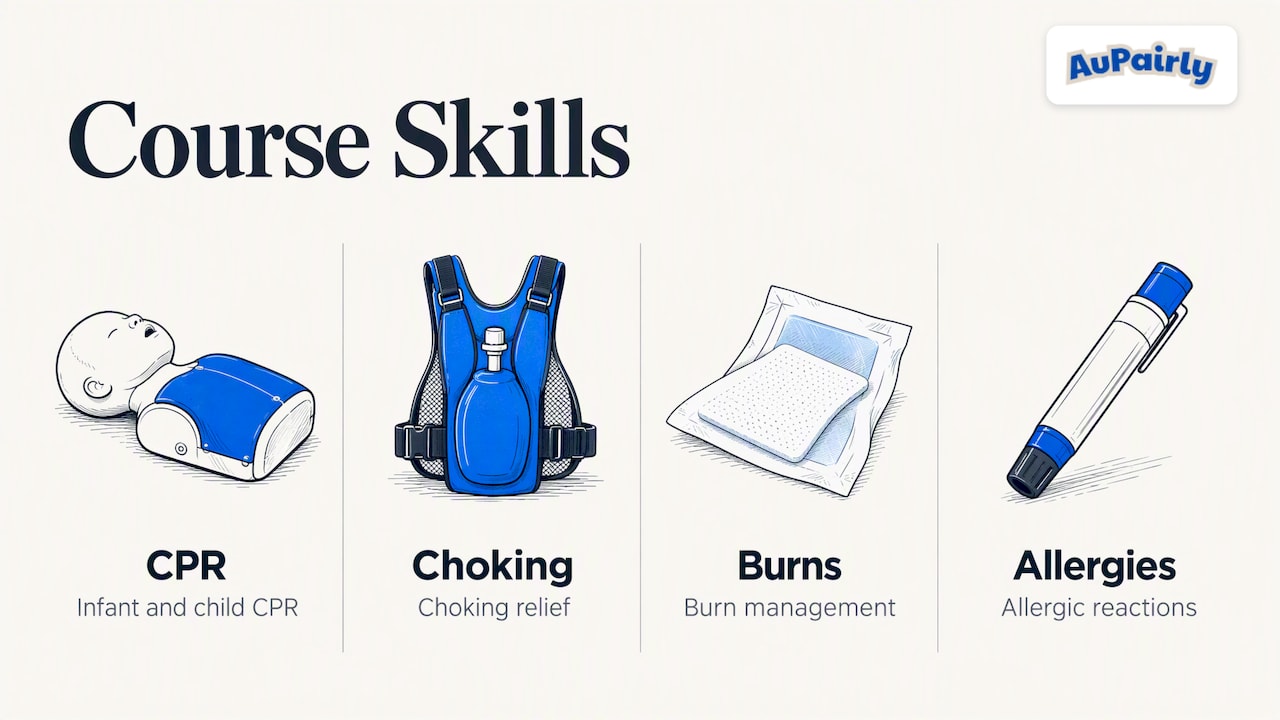
You don’t need a sitter who can handle everything. You need one who can handle the common, frightening things calmly. South African courses typically cover infant and child CPR, choking relief, burn management and allergic reactions, and that’s a sound checklist.
Choking
Choking is the one that worries most parents, and with good reason. Small children put things in their mouths, and a sitter who has only read about back blows is a long way from one who has practised on a training manikin. Infants and older children are treated differently, so look for a course that teaches both, with hands-on practice.
CPR for babies and children
Child CPR isn’t the same as adult CPR. Depth, hand position and breath ratios change with age. The American Heart Association and the American Academy of Pediatrics publish the 2025 guidelines for paediatric basic life support, which many courses build on. You don’t need to read them. You do need your sitter to have learned from a current course, not a ten-year-old certificate.
Burns, cuts and falls
Kettles, stoves, hot bath water and braai coals are everyday risks. A sitter should know how to cool a burn, deal with bleeding, and recognise a head injury that needs a doctor. A good instructor will also tell them when not to treat and just call for help.
Allergic reactions and asthma
This is where you come in. Professionals urge parents to be open about specific needs such as asthma or food allergies at the interview. A sitter can only act on what they know. Show them the inhaler or auto-injector, explain when it’s used, and write it down.
Knowing when it’s an emergency
The hardest skill is deciding. We tell families to say it plainly: if you’re worried enough to ask whether to call, call. A sitter should never feel they’ll be in trouble for phoning an ambulance.
Choosing a first aid course in South Africa
There’s no single national babysitter qualification. What you’ll find is a mix of private trainers, healthcare training centres and first aid associations. Here’s how to tell them apart.
| What to check | Why it matters |
|---|---|
| Infant and child content | Adult-only CPR isn’t enough for a childcare role |
| Hands-on practice | Skills fade if you’ve only watched a video |
| Accreditation | RCSA or AHA are the names childcare agencies commonly look for |
| Instructor background | Trainers with ambulance, ER or ICU experience bring real cases into the room |
| Certificate dates | First aid certificates expire, so ask when the course was done and when it lapses |
Where to look
We don’t rate training providers, but these are examples of the kinds of places that offer courses, so you know what to search for:
- Specialist CPR trainers. Survival CPR was founded in 2001 by Sister Catherine Rodwell, a trauma and ICU nurse with experience in medical evacuations across Africa.
- Healthcare training centres. Critical Care Training runs AHA courses, including instructor-led Basic Life Support. That one is aimed at healthcare providers, so a sitter should ask for a family-and-childcare option instead.
- Course lists with several levels. PEC lists Family and Friends CPR (AHA), CPR for Everyone (RCSA) and Heartsaver First Aid, CPR and AED courses.
- First aid associations. SASFAE offers a Basic First Aid Level 1 course as an introduction to emergency care.
- Online paediatric options. The AHA has an online Heartsaver Pediatric First Aid CPR AED course. Check with the provider whether a hands-on skills session is needed to get a certificate, and ask whether an employer will accept it.
We haven’t listed course prices, because they change and depend on the level, the provider and the city. Ask for a quote and what’s included. It’s also worth asking whether the course covers infants and children specifically.
Who pays?
There’s no rule here, and you’ll find families doing it both ways. If you’re hiring a regular au pair, some parents pay for or share the cost of a course as part of the working arrangement. That’s a conversation to have before the first day, and best written down.
How to check a certificate before you hire
A certificate in a message isn’t the same as a certificate you’ve seen. Whether you find a sitter through us or elsewhere, a few steps help.
- Ask early. Put it in your first message: “Do you have a current child and infant first aid and CPR certificate?”
- Look at the document. Check the name, the provider, the date and whether it covers children and infants.
- Ask what they remember. At the interview, ask: “A toddler is choking and can’t cough. What do you do first?” You’re listening for calm and a clear order of steps, not a perfect textbook answer.
- Check the references. Au pairs on AuPairly provide 3 references. Phone them, and ask how the person handled a difficult moment with a child.
- Do a paid trial. A short trial shift shows you how they behave around your kids, and how they react to your home’s rules.
Families tend to expect current, verified first aid training from a hired caregiver, and to check it themselves during the interview. That matches how we see it: the family does the final checks.
Set up your home so training can work
Even a fully certified sitter needs a home that’s ready. The most effective emergency preparation is local, so make sure the sitter knows where the nearest hospital is, where your first aid kit lives, and who to phone if they can’t reach you.
The fridge sheet
Paediatric safety guidance suggests leaving a list with any sitter. The HealthyChildren.org checklist includes parents’ phone numbers, neighbours’ numbers, the children’s doctor, fire and rescue, police, a poison helpline and your home address. That checklist is American, so swap in South African numbers. Write down:
- Both parents’ mobile numbers
- A neighbour or relative close by
- Your children’s doctor and your nearest hospital or emergency room
- The emergency numbers for ambulance and police in your area
- Your poison helpline number
- Your home address, written out, with a landmark or gate code
- Allergies, asthma plans and any regular medicine, with doses
Stick it where a nervous person will see it. Panic makes people forget their own address.
The first aid kit
Show the kit, don’t just mention it. Open it with your sitter, check nothing’s expired and point out the items they’re most likely to need: plasters, gauze, saline, a thermometer, any prescribed medicine. Put it somewhere children can’t reach but adults can find in the dark.
Walk-through
On the first shift, spend ten minutes walking around: the exits, the pool or its cover, the gate lock, the stove, the cupboard with cleaning products. If there’s a pool, say plainly who can go near it and when.
Where babysitting fits in
Not every family needs a full-time au pair. Sometimes you need an evening, a wedding or a school holiday day. The same first aid question applies to all of them, and the same checks too.
If you’re booking a short job, our guides can help you plan it: what to send a sitter before an evening booking, how to handle a date night handover, booking a babysitter for a wedding, and last-minute school holiday cover. If you’re weighing options, our piece on daycare versus a babysitter covers age and safety checks.
For babysitters of any age, the sensible rule is the same: the younger the child, the more the first aid training matters.
How we think about this at AuPairly
We’re a small team, and we’ll be honest about what we do and don’t do.
An admin reviews every au pair profile before it goes live. We check profiles for completeness, quality and authenticity. We think of it as a quality gate, so you’re browsing profiles reviewed for completeness rather than half-filled pages. It isn’t a background check, and we don’t do employment vetting. Families make their own final checks, and a first aid certificate is one of the first things to check.
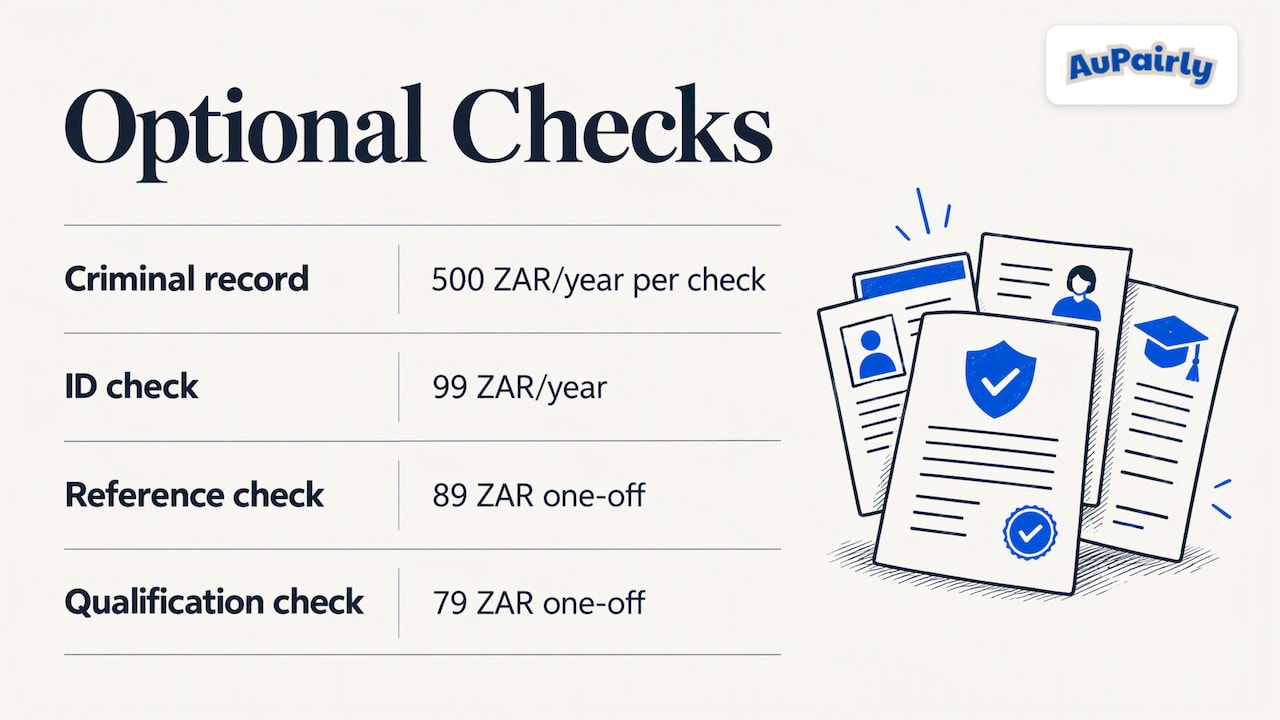
We also offer optional add-ons if you want more: a criminal record check for 500 ZAR per year per check, an ID check for 99 ZAR per year, a reference check for 89 ZAR one-off and a qualification check for 79 ZAR one-off. A qualification check is a sensible place to start when you want a first aid certificate looked at properly. These are optional, and they sit on top of your own conversations, not in place of them.
What we’d say to any parent: don’t treat a certificate as a tick box. Treat it as the start of a conversation about how your sitter will handle your child’s specific needs. A sitter who has done a course will usually have questions of their own, and that’s a good sign.
For au pairs reading this: a current child first aid and CPR certificate makes your profile stand out, and it’s one of the first things families ask about. Registering with us is free. Our Au Pair Safety Guide explains your rights in South Africa.
— Nicole
Finding an au pair who has the training you want
When you’re ready to look, start with where you live. Our au pairs by area page lets you browse by city and province, and you can message au pairs directly once you’ve subscribed. Families pay to make contact and hire, while au pairs join and use the platform for free.
On our pricing page, 7-Day Access is 249 ZAR per week and 30-Day Access is 449 ZAR per month. There are no agency fees. Many families pick the 7-Day option when they need someone quickly, then switch to 30 days once they’re in conversations and arranging trial shifts.
When you message, ask about first aid in your first note. It saves everyone time.
Questions to ask at the interview
Here’s a short list you can copy.
- Do you have a current child and infant first aid and CPR certificate? When does it expire?
- Who ran the course, and was it hands-on?
- Have you ever had to deal with a child choking, a fall or an allergic reaction? What happened?
- What would you do if you couldn’t reach us?
- Are you comfortable with our house rules about pool, screens and food?
- Can you give us 3 references, and may we call them?
And the questions you should expect from them:
- Does any child have allergies, asthma or regular medicine?
- Where’s the first aid kit and the nearest hospital?
- Who do I call first if something goes wrong?
FAQ
Does a babysitter need a first aid certificate in South Africa?
We’re not aware of a single legal requirement that applies to every private babysitter, but most families, and many agencies, expect one for regular childcare. For your own child’s safety, we’d treat it as a must-have for anyone looking after babies or toddlers. If a family has special medical needs, ask for more than the basics.
What’s the difference between first aid and CPR?
First aid covers the wider range of injuries and illnesses, such as burns, bleeding, choking and allergic reactions. CPR is the specific skill used when someone isn’t breathing normally and their heart may have stopped. Good childcare courses teach both, for infants and for older children.
Is an online first aid course enough?
Online learning can build knowledge, and some providers, such as the AHA, offer online paediatric first aid courses. CPR and choking relief are physical skills, though, so we’d prefer a sitter who has also practised hands-on with an instructor. Ask the provider what the certificate involves.
How often should a sitter refresh their training?
Certificates carry an expiry date, and the provider can tell you what applies to your course. As a rule of thumb, ask for a date on the certificate and agree with your sitter when to renew. Guidelines are updated from time to time, so a recent course is better than an old one.
What should I do if my sitter has no certificate yet?
You can still hire them if you trust them, but make a plan. Agree a date by which they’ll book a course, decide who pays, and keep jobs simple until then. For babies, we’d wait.
Sources
- Babysitting Reminders: Checklist for Parents and Sitters, HealthyChildren.org
- Critical Care Training
- About Survival CPR
- PEC CPR and First Aid courses
- SASFAE Basic First Aid Level 1
- AHA Heartsaver Pediatric First Aid CPR AED
- AHA Part 6: Pediatric Basic Life Support
Recommended
- Date Night Babysitter: SAQA Safety and Handover in South Africa
- Evening Babysitting: 9 Details to Send Before Booking in South Africa
- Daycare or Babysitter in South Africa: Age Advice, Safety Checks
- Weekend Babysitter: 6 Checks and UIF Basics for South African Parents
Quick note: This was written with AI, and then reviewed by our lovely team of 4. We’ve edited to make sure it doesn’t sound like a computer wrote it, but if it reads more robot overlord than human copywriter please let us know. 😊