Au Pair Share in South Africa: How to Split an Au Pair Between Two Families

An au pair share means two families split one au pair’s working week between them. Each family gets reliable help, usually at a lower cost than hiring alone, and the au pair gets a fuller schedule from one arrangement. It works well when the two families live close together, have children of similar ages and agree on the rules before day one. It goes wrong when nobody puts the details on paper.
We’re AuPairly, and we help South African families find au pairs directly, with no agency fees. Here’s how a share works, what the law expects of you, and how to set one up so it lasts.
TL;DR
- A share is a three-way agreement between Family A, Family B and the au pair. Write it down before anyone starts.
- Au pairs in South Africa count as domestic workers, so the national minimum wage, UIF and COIDA rules still apply.
- Pick a family close by, with kids of a similar age and the same views on screen time, discipline and food.
- Agree up front what happens when one child is sick, when school is closed and when someone’s plans change.
- You can browse admin-reviewed profiles on AuPairly and message au pairs once you subscribe. The final checks are always yours.
Table of Contents
- What an au pair share actually is
- Who a share works for
- Step 1: Find the other family
- Step 2: Agree the basics together
- The legal side: au pairs are employees
- Step 3: Write the share agreement
- What a share can cost
- How we see it: a note from our side
- Step 4: Find the right au pair
- Step 5: Run a trial and review it
- Common problems and how to avoid them
- What if a share isn’t right for you?
- Start your search with AuPairly
- FAQ
- Sources
What an au pair share actually is
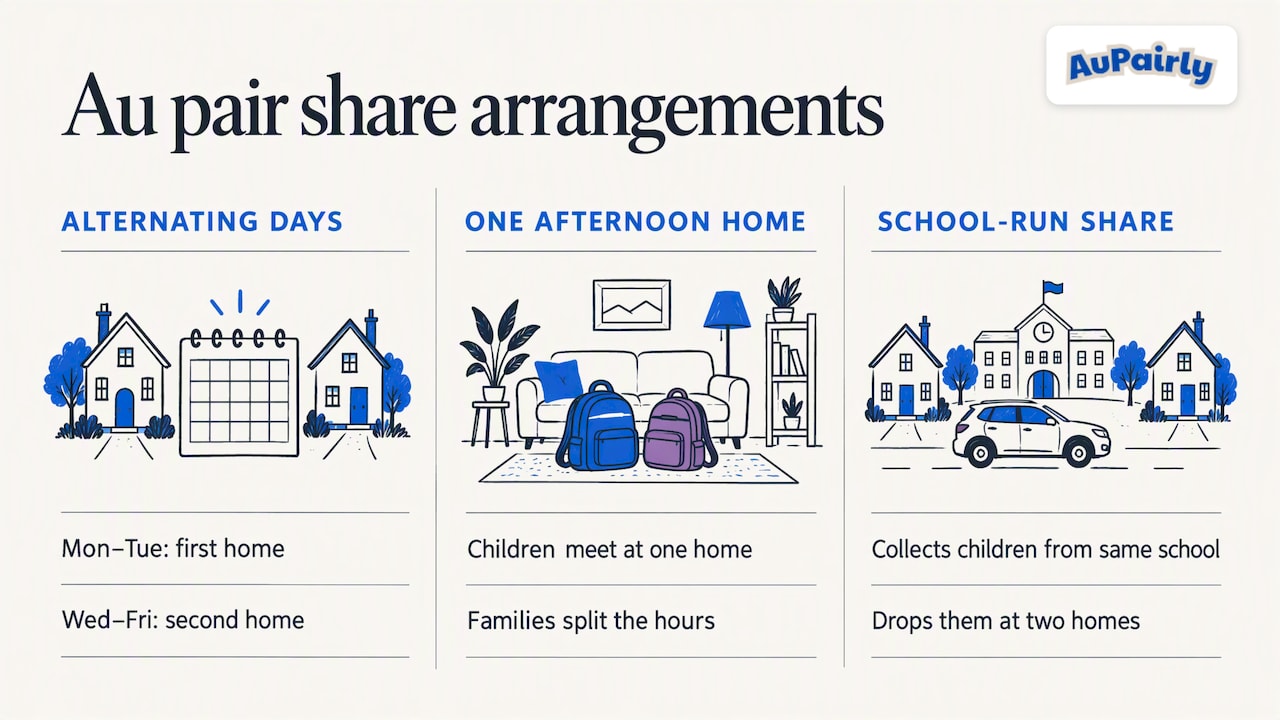
In a share, one au pair looks after children from two households. Some families alternate days: Monday and Tuesday at one house, Wednesday to Friday at the other. Others bring the children together at one home each afternoon and split the hours. A third pattern is a school-run share, where one au pair collects children from the same school and drops them at two homes.
You’ll often hear it called a nanny share. The idea is the same. A nanny share splits childcare costs between families, and the children get company their own age plus one consistent caregiver.
An au pair share suits South African families for a practical reason. Au pairs here are usually younger people, often students or recent matriculants, who give part-time, flexible care, such as school pick-ups, homework help and driving to activities. That afternoon pattern is easy to split between two households.
Who a share works for
A share is a good fit if:
- Both of you work, and neither needs full-time live-in help.
- You live in the same suburb, estate or along the same school route.
- Your children are within a couple of years of each other.
- You can both be flexible and talk openly when something isn’t working.
It’s a poor fit if one family wants a strict routine and the other likes things loose, or if one of you needs care at short notice every week while the other needs the same fixed hours. Be honest about that early. It saves everyone awkward conversations later.
Step 1: Find the other family
Start with people you already know. School WhatsApp groups, your estate’s community page, aftercare parents and neighbours are the easiest places to ask. A family you already trust a little makes the whole thing smoother.
Before you commit, have a proper chat about:
- Where you live and how far apart your homes are.
- Your children’s ages, school times and after-school activities.
- Which days and hours each family needs.
- Whether you each have a car, and who covers transport.
- Your views on screen time, snacks, naps, homework and discipline.
That last point matters more than most people expect. Childcare experts say the most successful shares are those where families align on their parenting approach before hiring. Differences in discipline, screen time and diet can quickly overwhelm an au pair who is answering to two households.
Step 2: Agree the basics together
Sit down, just the two families, and work out a simple plan before you look at a single profile.
- The schedule. Which days, which hours, and which home. Write down school holidays too.
- The location. One home, alternating homes, or pick-ups only.
- Who is the employer. This is the big one. We cover it in the legal section below.
- Costs. How wages, transport, fuel and food are split. Equal hours should mean equal cost. Unequal hours should mean a fair split.
- Rules. Screen time, snacks, outings, discipline, who the au pair can have around the children.
- Backup plan. What happens when a child is sick, when one family is on holiday and when the au pair is ill.
A sick child is the classic share problem. Experts say every contingency, including what happens when one family’s child is sick, should be written into a formal contract before you start. If one child has a cold, does the other family still bring theirs? Does the au pair still come? Decide now, not on a Tuesday morning at 6:30.
The legal side: au pairs are employees
This is the part families skip, and it’s the part that can cost you later. In South Africa, an au pair is a domestic worker in the eyes of the law. Sharing doesn’t change that.
Minimum wage
Domestic workers are covered by the Domestic Worker Sector rules under the Basic Conditions of Employment Act, and the government has confirmed that domestic workers are entitled to be paid at least the National Minimum Wage. The rate changes each year in March, so check the current figure with the Department of Employment and Labour before you agree a rate. Whatever you pay is on top of that floor, never under it.
We don’t quote pay rates in our articles, because they depend on the area, hours, experience and number of children. For real figures, use our regional salary guides for Johannesburg, Cape Town and Durban, or try the au pair salary calculator.
UIF and COIDA
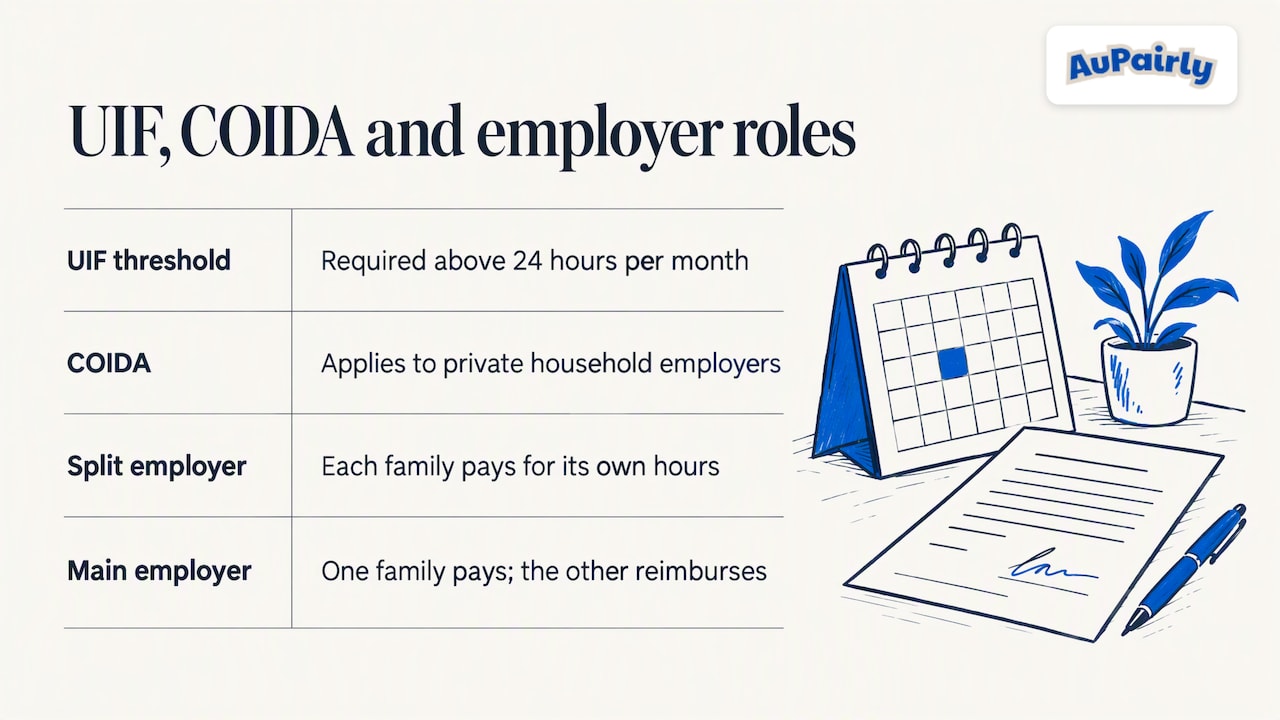
The government says any employee who works for you for more than 24 hours per month must be registered with the Unemployment Insurance Fund. COIDA, the compensation fund for injuries on duty, also applies to private household employers, and the Department of Labour publishes a notice on registering and claims for private domestic employers.
Legal professionals warn that families often assume they can skip registration because the au pair is a student or part-time. If your au pair works more than 24 hours a month, she or he is an employee.
In a share, the practical question is how the hours are counted between the two households. Some families split the employer role, with each paying for their own hours. Others name one family as the main employer and reimburse that family. Both can work, but each family should check its own position with the Department of Employment and Labour or a labour-law adviser before you sign. We aren’t lawyers, and we won’t pretend one answer fits every share.
Accommodation
Most shares are live-out, but if your au pair sleeps over at either home, the room has to meet certain rules. We’ve covered that in 7 steps to make au pair accommodation lawful in South Africa.
Step 3: Write the share agreement
A written agreement protects the au pair and both families. It doesn’t need to be fancy. One clear document, signed by all three, covers most problems before they happen.
Include:
- Names and contact details for both families and the au pair.
- Start date and a trial period, for example the first month.
- Working days, hours and location, plus holiday arrangements.
- Pay, how it’s split, pay day and who actually makes the payment.
- UIF and COIDA arrangements, and who handles the paperwork.
- Duties for each household (see below).
- Transport, fuel and petrol arrangements.
- Sick-child and sick-au-pair rules.
- Notice period for any of the three to leave.
- How you’ll check in, such as a short monthly chat with all three.
Be careful with duties. Au pairs focus on child development, stimulation and school-related transport. They’re not there for general housekeeping, and asking for cooking or cleaning is scope creep best avoided by hiring a separate domestic worker. With two households, this gets worse, because each family may quietly expect a bit extra. Our guide to au pair duties in South Africa explains where the line sits. Keep the lists identical for both homes so nobody feels short-changed.
What a share can cost
We won’t put rand figures on wages, but we can show you how the maths works.
Suppose one family hires an au pair for 20 hours a week. Alone, that family pays for all 20 hours. In a share, if the au pair works 10 hours for each family, each family pays for 10 hours. The hourly rate doesn’t drop. What drops is your total bill, because you only pay for the time you use.
There are a few things that can push the bill up, so budget for them:
- Petrol or transport costs, especially with two homes and a school run.
- UIF contributions and COIDA registration.
- Food and snacks if the children eat at one house.
- Extra pay for evenings or weekends.
The flip side is that a share may let you offer a better, more stable week to a good au pair. Two families booked in make a fuller schedule, and that helps you keep someone for the long run.
How we see it: a note from our side
We built AuPairly so families could find au pairs without an agency taking a cut, and we’ve watched a lot of families work out how to arrange care. Here’s our honest view on shares.
The best ones start with trust between the two families, not with the au pair. If you can’t picture sitting down with the other parents and saying “this isn’t working,” don’t do it. The au pair shouldn’t be the one who has to referee.
We also think the paperwork is not optional. We’ve seen how quickly a casual arrangement turns into a row about hours, petrol or who pays when school’s closed. A page of agreed terms is cheaper than a broken friendship.
What we do on our side is simple. Our admin team reviews every au pair profile before it goes live. We check profiles for completeness, quality and authenticity. It’s a quality gate, not a background check. We don’t claim to run criminal record screening as standard, and we don’t vet anyone’s employment history. You and the other family still do the final checks yourselves. That’s the honest picture, and we’d rather you hear it from us.
One more thing. Whoever you choose should be someone both families feel comfortable around, not just the cheapest option. Two sets of parents mean two sets of instincts, and you should both feel good about the person.
— Nicole
Step 4: Find the right au pair
Once you’ve agreed the plan, you can search together. Sit with the other family and look at profiles at the same time. It’s quicker than sending screenshots back and forth.
What to look for:
- Location. Choose someone based near both homes. You can browse by area on our au pairs by area page.
- Availability. Check that the days and hours match your plan.
- Experience with groups. Has she looked after more than one child, or children of different ages?
- Qualifications. First aid, early childhood training or tutoring experience can help. See what families look for in au pair qualifications.
- Personality. Patient, calm and organised matters more in a share than in a one-family job.
- Transport. Ask whether the au pair has a licence and whether she is comfortable driving other people’s children. Agree who covers car cover and fuel.
The benefits of choosing the right person go beyond the basics. Our article on au pair benefits in South Africa explains what a fair package looks like, which helps when you’re making an offer as two households.
Check references and do your own checks
Every au pair on our platform provides 3 references. Call all three, ideally together with the other family, so you both hear the same answers. Ask about reliability, how she handled more than one child, and how she dealt with a bad day.
If you want extra checks, we offer optional add-ons for families: an ID check at R99 per year, a reference check at R89 one-off, a qualification check at R79 one-off, and a criminal record check at R500 per year per check. These are optional and separate from our profile review. With two households involved, splitting the cost of the checks is a sensible thing to do.
Au pairs also have rights and a safety guide of their own. If you’re curious how things look from her side, read our au pair safety guide.
Step 5: Run a trial and review it
Don’t commit to a year on day one. Agree a trial of four to six weeks, then sit down all together and ask:
- Are the hours working for both families?
- Are the children getting along?
- Is the au pair comfortable, or does she feel pulled in two directions?
- Is the cost split still fair?
- Does anything in the contract need to change?
Adjust, write the changes down and carry on. A short, regular check-in works better than one big conversation after months of quiet frustration.
Common problems and how to avoid them
| Problem | What usually causes it | How to avoid it |
|---|---|---|
| One family always runs late | No clear pick-up and drop-off times | Put exact times in the agreement and agree what late means |
| Au pair feels overloaded | Two sets of expectations | Use one shared duties list and one point of contact |
| Argument about pay | Unclear split or pay day | Write the split down and agree who pays whom, and when |
| Sick-child chaos | No backup plan | Agree a rule for sick days before you start |
| Parenting clashes | Different views on screens, food or discipline | Talk it through first and give the au pair a single set of house rules |
| Family leaves the share | No notice period | Agree notice for all three parties |
What if a share isn’t right for you?
Not every family needs one. If your schedule is irregular, or you can’t find a second family nearby, hiring an au pair on your own is simpler. You get a single set of rules, a single contract and full control of the week.
And if you only need help occasionally, such as an evening out or a last-minute gap, babysitting may suit you better than a regular arrangement. We cover urgent babysitting requests on the platform as well, so you don’t have to commit to a weekly schedule to get help.
Start your search with AuPairly
Au pairs use AuPairly for free, and families pay to contact them. Right now you can choose 7-Day Access at R249 per week or 30-Day Access at R449 per month. That gives you time to browse admin-reviewed profiles, message au pairs directly and talk through a share with a candidate. If you’re an au pair looking for local work, you can register for free.
Ready to look? Browse au pairs on AuPairly and find someone both families feel good about.
FAQ
Is there a free au pair agency?
Au pairs themselves join AuPairly for free. Families pay a subscription to message and hire them, but there are no agency fees on top. Be wary of any service that promises everything for nothing, because someone is always paying for the matching and the profile checks.
Do au pairs cook and clean?
Au pairs are there for childcare, which means things like school runs, homework help and playing with the children. Light tidying after the kids is normal, but general housekeeping and cooking for the whole family isn’t part of the job. If you need that too, hire a separate domestic worker.
What is the age limit for au pairs?
In South Africa, au pairs are generally aged between 18 and 30, though non-citizens must be aged 18 to 24 for the au pair programme. Age is only one factor. Experience, references and personality tell you much more about whether someone suits your children.
Do both families need to register for UIF in a share?
It depends on how you set up the employer role and how the hours are split. The rule is that any employee working more than 24 hours per month must be registered with the UIF. Ask the Department of Employment and Labour, or a labour-law professional, how it applies to your share before you start.
Sources
- What to know about nanny shares, Cultural Care
- Hiring a Nanny or Au Pair in South Africa: A Parent’s Guide, Yebo Work
- Basic Conditions of Employment Act: Sectoral Determination 7, South African Government
- All domestic workers are entitled to be paid according to the National Minimum Wage, Department of Employment and Labour
- How do I register my domestic worker with the UIF? South African Government
- Private domestic employer registration and claims procedure, Department of Employment and Labour
Recommended
- Au Pair Duties in South Africa: Childcare, Not Heavy Housework
- Find an Au Pair in South Africa: 5 Profile Details That Save Time
- Au Pair Qualifications in South Africa: What Families Look For
- Research Backed Au Pair Benefits in South Africa, From R30.23/hr
Quick note: This was written with AI, and then reviewed by our lovely team of 4. We’ve edited to make sure it doesn’t sound like a computer wrote it, but if it reads more robot overlord than human copywriter please let us know. 😊